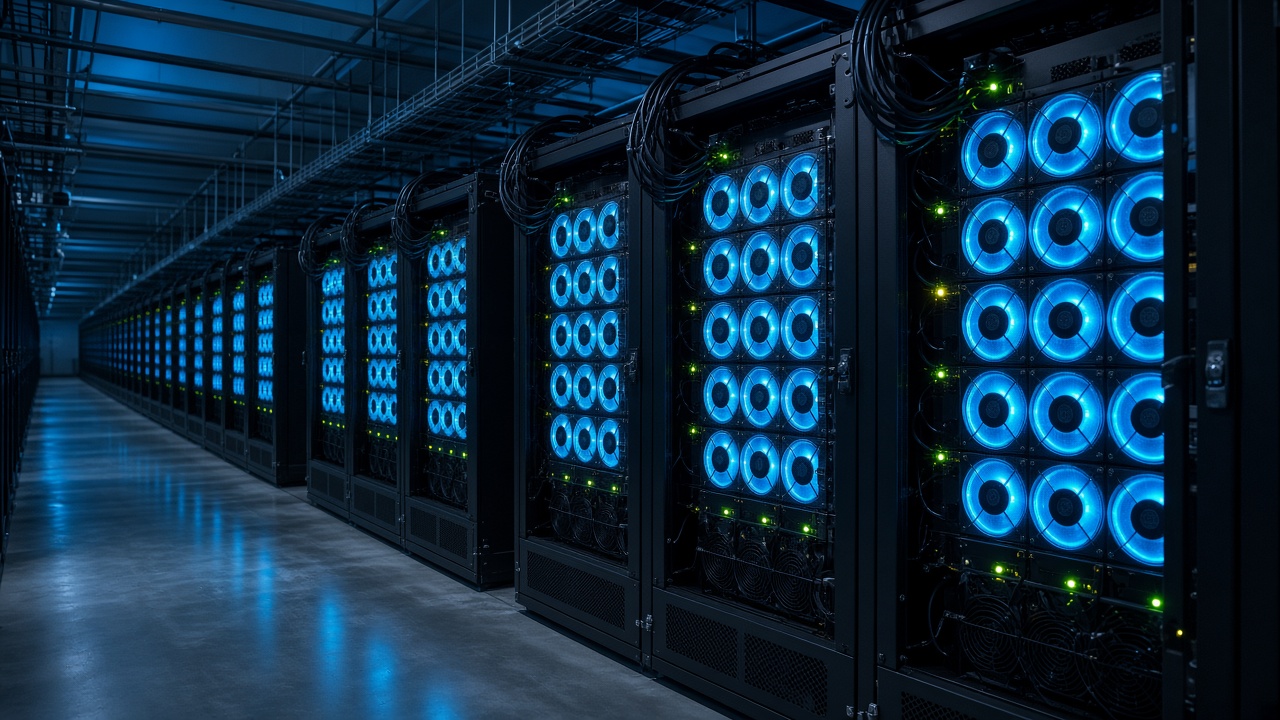
Bitcoin mining is one of the most misunderstood parts of the system. Headlines mention warehouses of humming machines, huge electricity bills and fortunes made or lost, but few explain what miners actually do or why it matters. In reality, mining is the process that secures the Bitcoin network, orders transactions and releases new coins on a predictable schedule.
This guide explains how mining works step by step, what equipment and costs are involved, how rewards are earned, and how to think about energy use and profitability. It is educational, not advice.
What Miners Do
Miners perform three essential jobs:
- Collect and verify transactions broadcast by users.
- Package them into blocks and add those blocks to the blockchain in order.
- Secure the network by spending real resources, which makes rewriting history prohibitively expensive.
In return, miners receive a block reward consisting of newly issued bitcoin plus the fees paid by users whose transactions were included.
Proof of Work in Simple Terms
Imagine a lottery in which tickets are free to scratch but each scratch costs electricity. A block header contains the data for the candidate block, including a reference to the previous block, a summary of the transactions and a number called a nonce. Miners run this data through a cryptographic function, SHA-256, which produces a seemingly random output called a hash.
The network sets a target. A valid block hash must be lower than that target, which in practice means it must start with a certain number of zeros. There is no shortcut to finding such a hash. Miners change the nonce and try again, billions or trillions of times per second, until one finds a winner.
Verification is easy. Once a miner finds a valid hash, any node can check it with a single calculation. Hard to produce, easy to verify: that asymmetry is the heart of proof of work.
Mining Difficulty and the Ten-Minute Target
Bitcoin aims to produce a block roughly every ten minutes. If more miners join and blocks arrive faster, the network raises the difficulty. If miners leave, it lowers it. This adjustment occurs every 2,016 blocks, about two weeks.
As a result, the total computing power on the network, called the hash rate, can grow dramatically without speeding up the issuance of new coins. A higher hash rate means more energy and investment are committed to securing the network, which raises the cost of an attack.
Block Rewards and the Halving
Each block’s reward started at 50 bitcoin in 2009. About every 210,000 blocks, roughly four years, the reward is cut in half. This event is known as the halving. The reward has fallen in steps, and future halvings will continue until the reward approaches zero. Total supply is capped at 21 million coins.
Over time, transaction fees are expected to make up a larger share of miner revenue. Whether fees will be enough to sustain security in the long term is a major topic of debate among researchers.
The Evolution of Mining Hardware
- CPUs: In the early days, anyone could mine on a home computer.
- GPUs: Graphics cards offered a big speed boost.
- FPGAs: Programmable chips provided short-lived gains.
- ASICs: Application-specific integrated circuits are built for one task, SHA-256 hashing. They are thousands of times more efficient than general-purpose hardware and now dominate mining.
Today, serious mining requires ASIC machines. Their efficiency is measured in joules per terahash. Newer models use less energy per unit of work, making older machines unprofitable when prices or difficulty move against them.
Solo Mining vs. Mining Pools
Finding a block alone is like winning a lottery. A small miner might wait years or never succeed. Mining pools solve this by combining the hash power of many participants. When the pool finds a block, the reward is split in proportion to each miner’s contribution, minus a fee.
Common payout structures include:
- Pay per share: A steady payment for each unit of work submitted.
- Proportional and similar models: Payouts depend on blocks the pool actually finds.
- Full pay per share and others with different risk distributions.
Pools offer more predictable income, but concentrate influence. Community members watch to make sure no single pool controls too much of the network.
What Mining Costs
Key costs include:
- Hardware: ASIC miners can cost from hundreds to several thousand dollars each.
- Electricity: The largest ongoing expense. Power price is the single biggest determinant of profitability.
- Cooling and facility costs: Machines produce heat and noise.
- Internet and maintenance
- Pool fees
- Taxes and compliance
Industrial miners seek locations with cheap, abundant power, such as places with surplus hydroelectric, wind, solar or stranded natural gas.
Is Mining Profitable?
Profitability depends on a moving equation:
Revenue = (your hash rate ÷ network hash rate) × blocks per day × (block reward + fees) × bitcoin price
Profit = revenue − electricity − other costs
Variables change constantly. If the bitcoin price falls, difficulty rises or the halving cuts the reward, margins shrink. Many miners have gone bankrupt in downturns. For an individual with typical residential electricity prices, mining is often unprofitable, so anyone considering it should use a calculator, test realistic assumptions and consider hardware resale value.
Energy Use and the Environmental Debate
Bitcoin mining consumes significant electricity, comparable to some small countries according to various estimates. Critics argue that this energy use is wasteful and contributes to emissions when powered by fossil fuels. Supporters respond that:
- Mining is a flexible load that can use surplus or otherwise wasted energy.
- A growing share of mining uses renewables, though estimates vary.
- The energy secures a global monetary network, and its cost should be compared with other financial systems.
- Miners can help stabilize grids by shutting down during peak demand.
The debate continues, and data on energy mix and emissions are contested. Evaluate claims critically and look for transparent, independent sources.
Security: The 51 Percent Attack
If a single entity controlled more than half of the network’s hash power, it could in theory reorder recent transactions or double spend its own coins. It could not steal coins from other people’s wallets or change the rules arbitrarily, because nodes would reject invalid blocks. The cost of acquiring and running that much equipment makes such an attack extremely expensive on Bitcoin, and an attacker would risk destroying the value of their own investment.
Mining Alternatives for Participants
If you want exposure to the network without running machines, consider that:
- Buying bitcoin gives price exposure without operating costs.
- Cloud mining contracts are often scams or poor value, so investigate heavily.
- Shares of publicly traded mining companies carry company risk in addition to bitcoin price risk.
Common Misconceptions
- “Miners solve complex math problems.” They perform repeated guessing, not meaningful math puzzles.
- “Mining creates coins out of nothing.” New coins follow a fixed schedule and require resources.
- “Anyone can mine profitably on a laptop.” That has not been realistic for many years.
- “More miners mean faster blocks.” Difficulty adjusts to keep blocks near ten minutes.
Final Thoughts
Mining is the engine that secures Bitcoin and issues new coins according to rules that nobody can change unilaterally. It turns electricity and hardware into security, and it creates a competitive market where efficiency matters. Whether you are curious, considering an investment in the sector or just trying to understand headlines, grasping proof of work, difficulty and rewards gives you a solid foundation.
This article is educational and not financial advice. Mining involves substantial risks, and profitability can change quickly.